
Pike County Arrest Warrants Explained
An arrest warrant starts with probable cause. A judge must find reason to believe an offense happened and that the named person committed it. Pike County Magistrate Court hears these arrest and search warrant applications. A law-enforcement officer, a prosecutor, or a civilian can bring a complaint, affidavit, or application forward. The judicial officer weighs the facts. An accusation alone never forces a warrant. When probable cause holds up, the signed warrant authorizes an officer to arrest the subject; when it does not, the application is dismissed. A supported case may then be bound over for possible prosecution in the Superior Court of Georgia, Griffin Judicial Circuit. The Pike County Superior Clerk keeps the connected felony and misdemeanor files, accusations, indictments, warrants, bond forfeitures, and pleadings. The allegation still has to work its way through the criminal process.
Pike County Arrest Warrant Check Channels
Pike County posts no public searchable warrant roster. A reliable warrant check runs through several offices instead, because the Sheriff, Magistrate Court, and Superior Clerk each hold different records. Georgia's own guidance sends warrant questions to the sheriff of the county where the warrant may exist.
- Prepare the full name, date of birth, spelling variants, Pike County connection, and any case number.
- Call the Pike County Sheriff at 770-567-8431 and ask whether confirmation is available by phone or requires an in-person request.
- For Magistrate warrant, first-appearance, bond, or preliminary records, call 770-567-2004, especially criminal extension 207.
- For a Superior criminal file, call 770-567-2000, extension 2, and ask for status and the issuing court.
- If calls do not resolve the question, ask the custodian how to request an existing warrant, return, docket entry, or disposition.
The Sheriff's office sits at 89 Jackson Street in Zebulon. Georgia warns that staff may require identification, and an in-person inquiry can end in custody if a warrant exists. Call ahead and ask whether counsel or a relative may inquire for you. A blank online result does not prove that no warrant exists.
Inside a Pike County Arrest Warrant
Pike County publishes no sample arrest-warrant listing or standard local format. Ask the court or Sheriff which fields appear on the actual warrant and case file. A citation screen or an old case entry does not show current service status.
| Record identifier | A case, citation, or warrant number may identify the file, but no standard Pike format is published. |
|---|---|
| Named subject | Name and date of birth help distinguish records; public display of full identifiers was not verified. |
| Warrant basis | The file may connect the warrant to a complaint, affidavit, offense, and probable-cause finding. |
| Charge and class | The offense may be a felony, misdemeanor, ordinance matter, or another court-specific class. |
| Issuing court | The court name identifies the clerk that can confirm filings, hearings, and disposition. |
| Bond and conditions | Bond is case-specific; Pike publishes no countywide arrest-warrant bond schedule. |
| Service and return | Ask if the warrant is active, served, recalled, quashed, or returned; no local status-code list is published. |
Verify every detail with the Pike County court or Sheriff. Status can shift after arrest, surrender, bond, a judge's order, or return of service.
Pike County Probable-Cause Warrant Hearing
Pike Magistrate Court publishes a civilian pre-warrant process under O.C.G.A. § 17-4-40. A written application can lead to a noticed hearing unless the law permits immediate issuance. Witnesses testify at that hearing. The applicant may offer proof and cross-examine, while the accused may cross-examine and present evidence but cannot be forced to testify. The Magistrate pre-warrant page documents that process.
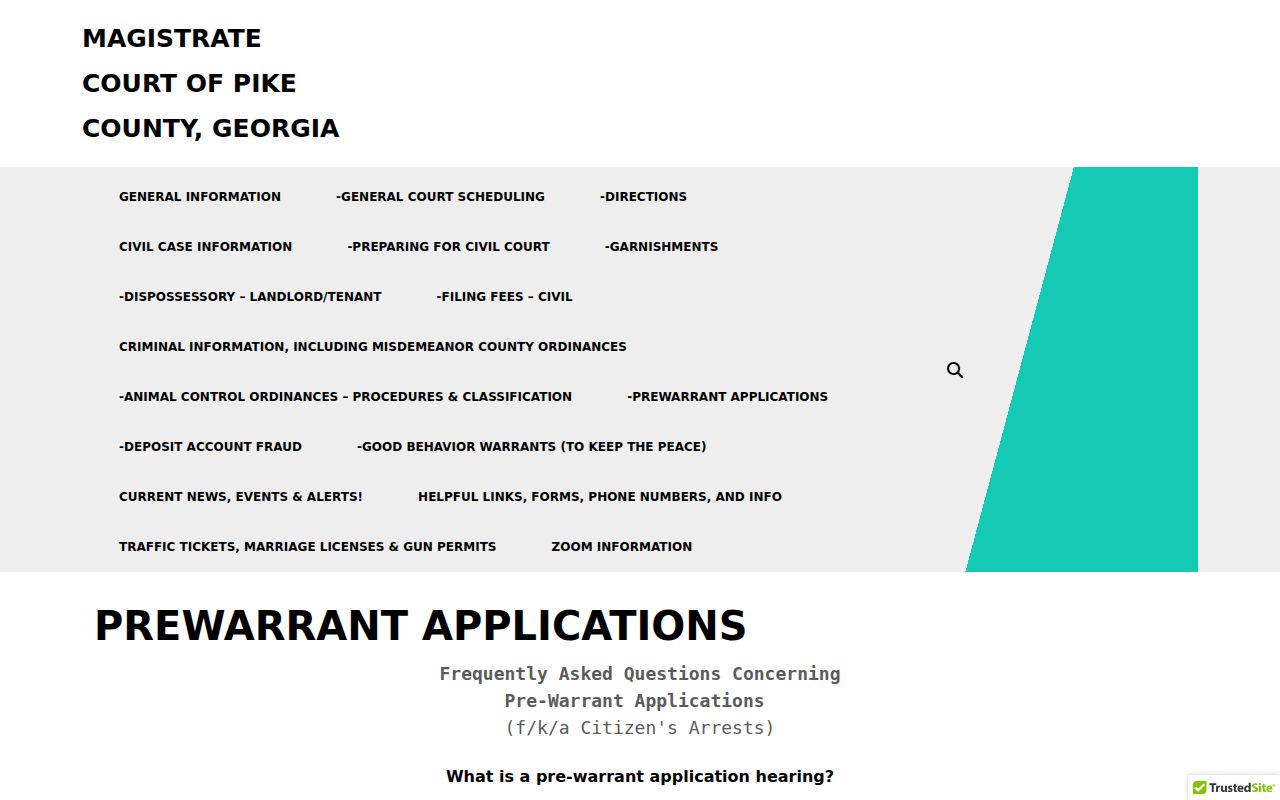
This is not an active-warrant lookup. It is one route by which a Pike County arrest warrant gets requested and tested. The judge may issue the warrant, dismiss it for lack of probable cause, or pass a supported matter onward.
Serving Arrest Warrants in Pike County
The Pike County Sheriff serves criminal warrants and runs the jail. City police or a municipal marshal may handle city matters. The GBI, Georgia State Patrol, other authorized agencies, or a fugitive task force can join when a case calls for it. Magistrate Court issues and hears warrants but is not the universal serving agency. Service puts the person in custody. Booking, first appearance, bond review, and later case routing follow. Pike County publishes no standard surrender hours, walk-in warrant counter, or single reporting place, so confirm the destination before travel. A 2025 GBI release on joint Pike work shows how execution may involve county, state, and regional partners. That release is not a public warrant list. The warrant record and assigned agency control each case.
Pike County Arrest Warrant Timing
Pike Magistrate Court offers local timing context. Its criminal page discusses 48-hour guidance for an arrest without a warrant and 72-hour guidance after arrest under a warrant. First-appearance and bond calendars generally run at 9 a.m. and 3 p.m. on weekdays, with emergency weekend proceedings when timing requires. The criminal-jurisdiction page displays those details. None of this promises release, a bond amount, or a result. Ask when the next hearing occurs, which Pike County court holds the file, and whether counsel must act before a deadline.
Comparing Pike County Arrest Warrants
An arrest warrant, a summons, and a bench warrant each direct different action. Pike County uses "bench warrant" or "failure-to-appear warrant" for court noncompliance and publishes no separate capias-pro-fine program. Follow the issuing court's exact label.
| Feature | Arrest Warrant | Summons | Bench Warrant |
|---|---|---|---|
| Direction | Arrest the named subject. | Appear on the stated date. | Arrest after a missed duty. |
| Basis | Probable cause of an offense. | A case handled by ordered appearance. | Failure to appear or comply. |
| Issuer | Authorized judge or magistrate. | Court or authorized process. | Judge handling the obligation. |
| Response | Counsel, surrender, and bond if allowed. | Appear and address the case. | Ask about reset, recall, appearance, and bond. |
A search warrant authorizes a search, not an arrest. Pike County also runs specialized good-behavior and deposit-account-fraud processes, so do not collapse those labels into arrest warrant without the real file.
Pike County Arrest Warrant Hearings
Two hearings do different jobs. First appearance brings the arrested person before a judicial officer. That is where rights and bond get addressed. A preliminary hearing instead tests whether the evidence supports moving the charge toward prosecution. Pike County generally schedules those hearings Thursdays at 1:30 p.m. The Magistrate schedule puts warrant, first-appearance, bond, and preliminary work on one calendar. The court warns that posting bond without timely confirming or waiving the preliminary hearing can affect that hearing and the transfer to Superior Court, so ask the clerk or a lawyer for the exact deadline. A calendar entry alone proves nothing about whether a warrant is active or cleared.
Pike County Arrest Warrant Access Limits
Georgia's Open Records Act, O.C.G.A. §§ 50-18-70 et seq., gives the public access to existing records. It does not create warrant lists. A focused request works best. Name the subject, date range, court, case number, warrant, return, or disposition. Ask for nonexempt portions. Ask the legal basis for any withheld items. A Pike County file may be sealed, tied to an active investigation, shielded by court order, or restricted because a juvenile is involved. The Superior Court Clerk holds records open except juvenile, adoption, and sealed matters. A warrant may be withheld before execution. A silent website cannot establish clearance. Who holds a Pike County file depends on the stage of the matter. The Sheriff keeps service information, the Magistrate clerk handles that court's warrant proceedings, and the Superior criminal clerk maintains the higher court file. Put your contact details in writing. State a delivery preference, and ask about any search or copy charge before work begins. The Pike County Sheriff publishes no request form, fixed response fee, email route, or public turnaround for warrant records, and one office's denial does not settle whether another holds a separate docket or return.
Access point: Request an existing court or service record, then verify its present status with the issuing court and Pike County Sheriff.
If There’s an Arrest Warrant for You
Confirm any warrant first. The Pike County Sheriff and the issuing court can verify an active arrest warrant. Record the basics. Note the office, date, case number, warrant type, bond information if disclosed, and next setting. Clerks and judges cannot advise you. The public defender in Thomaston, at 706-647-7020, answers questions about eligibility for appointed counsel. Counsel may arrange voluntary surrender. A lawyer can also set up a court walk-through or a motion to recall or quash. If surrender is required, pin down details. Confirm the intake place, the time, your identification, booking, and whether bond is set. Pike County publishes no countywide bond schedule, portal, surrender form, or standard release policy. Posting bond does not dismiss the charge. Keep the receipt, confirm the next date, ask when the court will notify the Sheriff, and recheck both offices; the county warrant response steps can help organize that work.
Important: Speak with a lawyer before surrender; an active arrest warrant can lead to custody during any law-enforcement contact.